
Imagine this: You wake up every morning struggling to breathe through your nose. You reach for tissues constantly, clearing thick mucus that never seems to end. Simple activities like eating or sleeping become exhausting battles. Your sense of smell has faded to a distant memory. Headaches plague you daily. You've tried medications, sprays, and countless remedies, but nothing provides lasting relief.
If this sounds familiar, you're not alone. Millions of people worldwide suffer from chronic rhinosinusitis with nasal polyps—a condition that can dramatically impact quality of life. The good news? Modern medicine offers a proven solution: Functional Endoscopic Sinus Surgery (FESS), particularly when enhanced with advanced microdebrider technology and endoscopic visualization.
Understanding Nasal Polyps: When Your Nose "Freezes"
What Are Nasal Polyps?
Nasal polyps are soft, painless, noncancerous growths that develop on the lining of your nasal passages or sinuses. Think of them as swollen tissue that has become so inflamed that it forms grape-like structures, hanging down and blocking the natural airways in your nose.
Here's a simple analogy: Imagine your nasal passages as highways for air to travel. Nasal polyps are like landslides that block these highways, preventing normal traffic flow. When these "roadblocks" form, air cannot circulate properly, mucus cannot drain, and your sinuses become a breeding ground for inflammation and infection.
(Allergies, Infections)
(Edema Formation)
(Mucosal Outgrowth)
(Breathing Problems)
The Science Behind Polyp Formation
At the molecular level, nasal polyp formation involves complex immune responses. In most cases, particularly in Western populations, polyps are associated with what doctors call "Type 2 inflammation." This means your immune system triggers specific cells (eosinophils) and inflammatory molecules (like IL-5, IL-4, and IL-13) that cause the lining of your nose and sinuses to swell excessively.
The exact trigger varies from person to person. Common causes include chronic allergies, aspirin sensitivity, asthma, cystic fibrosis, and repeated infections. In some individuals, genetic factors play a significant role—studies show that if you have a first-degree relative with nasal polyps, your risk increases more than four-fold.
Common Symptoms: Recognizing the Problem
Nasal polyps don't announce themselves dramatically. Instead, they gradually worsen your quality of life through persistent symptoms:
- Nasal Congestion and Obstruction: The most prominent symptom—feeling like your nose is perpetually blocked, forcing you to breathe through your mouth
- Loss of Smell (Hyposmia/Anosmia): Food loses its taste, you can't smell flowers or perfumes, and you may miss warning odors like gas or smoke
- Postnasal Drip: Constant sensation of mucus running down the back of your throat
- Facial Pressure and Pain: Feeling of heaviness or pain around your forehead, cheeks, and eyes
- Runny Nose (Rhinorrhea): Persistent nasal discharge that requires constant tissue use
- Snoring and Sleep Disturbance: Inability to breathe properly during sleep leads to fatigue and decreased productivity
- Recurrent Sinus Infections: When polyps block drainage, bacteria and fungi can accumulate, causing repeated infections
Different Types of Nasal Masses: Understanding the Distinction
Not all nasal growths are simple benign polyps. As a patient, understanding the difference is crucial:
| Type | Characteristics | Treatment Approach |
|---|---|---|
| Benign Nasal Polyps | Soft, painless, bilateral (both sides), associated with allergies or chronic inflammation | Medical management first, then FESS if medications fail |
| Antrochoanal Polyps | Single polyp arising from maxillary sinus, more common in children | Surgical removal only |
| Fungal Balls (Mycetoma) | Dense fungal debris, usually unilateral, may follow dental procedures | Surgical removal and sinus clearance |
| Allergic Fungal Rhinosinusitis (AFRS) | Thick eosinophilic mucin with fungal elements, may cause facial deformity if untreated | Aggressive surgical clearance followed by medical therapy |
⚠️ When Nasal Masses Become Dangerous: Invasive Fungal Sinusitis
While most nasal polyps are benign, there exists a rare but serious condition called invasive fungal sinusitis that requires immediate medical attention. This aggressive infection can spread beyond the sinuses to involve the eyes, brain, and surrounding structures.
Who is at risk? Primarily immunocompromised individuals—those with diabetes, cancer patients undergoing chemotherapy, organ transplant recipients, or patients on prolonged steroid therapy.
Warning signs requiring urgent care:
- Black or dark ulcers in the nose or mouth
- Severe facial pain with numbness
- Sudden vision changes or double vision
- Facial swelling or skin color changes
- Mental confusion or altered consciousness
- High fever despite antibiotics
Invasive fungal sinusitis carries a mortality rate of 50-80% if not treated aggressively with emergency surgery and antifungal medications. Early recognition saves lives. If you have risk factors and develop these symptoms, seek immediate medical attention.
Complications of Untreated Chronic Rhinosinusitis
Many patients ask: "Can I just live with this?" While nasal polyps themselves are benign, leaving chronic rhinosinusitis untreated can lead to serious complications:
Local Complications
- Mucocele Formation: Mucus-filled cysts in the sinuses that can expand and erode bone
- Nasal Bone Changes: Long-standing polyps can cause widening of the nasal bridge (broadening of the nose)
- Chronic Cough: Persistent postnasal drip irritates the throat and airways
Orbital Complications (Eye-Related)
- Periorbital Cellulitis: Infection of tissues around the eye causing swelling and redness
- Orbital Abscess: Pus collection behind the eye that can threaten vision
- Vision Loss: Pressure on the optic nerve or infection spreading to the eye socket
Intracranial Complications (Brain-Related)
- Meningitis: Infection of the protective membranes covering the brain
- Brain Abscess: Pus collection in brain tissue
- Cavernous Sinus Thrombosis: Blood clot in major veins near the brain—a life-threatening emergency
These complications, while rare with modern treatment, underscore why addressing chronic sinus disease is not merely about comfort—it's about preventing potentially catastrophic health consequences.
The Foundation: Medical Management Before Surgery
Here's something crucial that every patient should understand: FESS surgery is not the first line of treatment. Surgery comes into play when medical management has been thoroughly tried and found insufficient.
Why Medical Treatment Comes First
Nasal polyps form due to inflammation. Therefore, the first step is always to control that inflammation with medications:
- Intranasal Corticosteroid Sprays: These reduce inflammation directly at the site (examples: fluticasone, mometasone, budesonide)
- Nasal Saline Irrigation: Mechanical cleansing helps remove allergens, bacteria, and inflammatory debris
- Oral Corticosteroids: Short courses for severe symptoms (used cautiously due to side effects)
- Antihistamines and Leukotriene Inhibitors: For allergy-related polyps
- Biologics (Newer Option): Medications like dupilumab that target specific inflammatory pathways—effective but expensive
When Surgery Becomes Necessary
If you've been on appropriate medical therapy for at least 12 weeks without significant improvement, or if you have complications, surgery becomes the next step. But here's the key point: Surgery doesn't replace medical management—it enhances it.
Think of it this way: Medical sprays and rinses can't reach your sinuses when polyps block all the pathways. FESS surgery removes the polyps and opens up your sinus drainage pathways, creating "highways" that allow medications to actually reach where they need to go. After surgery, continued medical management prevents polyps from returning.
(Endoscopy + CT Scan)
(12+ weeks)
(Symptom Relief?)
(If Needed)
(Medical Therapy)
The Modern Solution: Functional Endoscopic Sinus Surgery (FESS)
What is FESS?
Functional Endoscopic Sinus Surgery revolutionized how we treat chronic sinus disease. Unlike older techniques that required cutting through the face or gums, FESS is performed entirely through your nostrils—no external scars, no facial incisions.
The surgery has three main goals:
- Remove Polyps and Diseased Tissue: Clear the obstructions blocking your airways
- Open Sinus Drainage Pathways: Widen the natural openings of your sinuses so mucus can drain properly
- Preserve Healthy Mucosa: Keep as much normal tissue as possible to maintain natural sinus function
How FESS Works: Step by Step
- Anesthesia: You'll be under general anesthesia—completely asleep and pain-free
- Endoscope Insertion: A thin tube with a high-definition camera is inserted through your nostril, giving the surgeon a magnified view of your nasal and sinus anatomy
- Polyp Removal: Using specialized instruments (including the microdebrider), the surgeon carefully removes polyps and diseased tissue
- Sinus Opening: Natural sinus openings are widened to ensure proper drainage
- Hemostasis: Bleeding points are carefully controlled
- No Packing (Usually): Modern techniques often eliminate the need for uncomfortable nasal packing
What Makes FESS Different from Old-Style Sinus Surgery?
| Aspect | Traditional Surgery | Modern FESS |
|---|---|---|
| Approach | Through face or gums (Caldwell-Luc) | Through nostrils only |
| Visualization | Limited, surgeon working "blind" | High-definition endoscopic view |
| Tissue Preservation | Extensive removal, including healthy tissue | Precise removal of only diseased tissue |
| Recovery Time | 2-3 weeks | 1-2 weeks |
| Scarring | External scars on face | No external scars |
| Pain Level | Significant | Mild to moderate |
| Success Rate | Variable | 85% symptom improvement |
The Microdebrider Advantage: Precision Engineering for Better Outcomes
What is a Microdebrider?
A microdebrider is a specialized powered surgical instrument that has revolutionized FESS. Think of it as a highly sophisticated vacuum cleaner combined with a precision cutting tool. It has three components working together:
- Cutting Blade: A rotating or oscillating blade that precisely removes tissue
- Suction Mechanism: Simultaneously removes cut tissue and blood from the surgical field
- Variable Speed Control: Surgeon can adjust speed (up to 15,000 rotations per minute) for different tissue types
| Feature | Conventional Forceps | Microdebrider |
|---|---|---|
| Precision | Tears and strips tissue | Precise cutting with micron-level accuracy |
| Blood Loss | More bleeding obscures view | Continuous suction maintains clear field |
| Tissue Trauma | More trauma to surrounding tissue | Minimal trauma, preserves healthy mucosa |
| Operating Time | Longer (averaging 163 minutes) | Shorter (averaging 130 minutes) |
| Healing | More scarring and synechiae formation | Faster healing, less scarring |
| Functions | Separate instruments for cutting, removing, suctioning | All functions in one device |
Clinical Benefits You'll Experience
1. Reduced Blood Loss: The continuous suction keeps the surgical field clear. Studies show significantly less intraoperative bleeding compared to conventional instruments, which means:
- Better visibility for the surgeon throughout the procedure
- More complete removal of disease
- Reduced risk of complications
2. Faster Surgery: Research demonstrates that microdebrider-assisted FESS reduces operating time by approximately 37%. Shorter anesthesia time means:
- Lower anesthesia risks
- Less tissue swelling
- Faster recovery
3. Superior Precision: The microdebrider can be accurate to within microns (thousandths of a millimeter). This precision means:
- Diseased tissue is completely removed
- Healthy tissue is preserved
- Lower recurrence rates
4. Better Postoperative Healing: Because there's less trauma to healthy tissue:
- Less crusting and scarring
- Faster restoration of normal ciliary function (the tiny hairs that move mucus)
- Reduced formation of adhesions (synechiae)
- Better long-term outcomes
Patient Outcome Data: Studies show that patients undergoing microdebrider-assisted FESS report significantly greater symptomatic improvement compared to conventional techniques, with 89% achieving normal quality-of-life scores post-surgery.
Why Endoscopic Visualization Changes Everything
The Power of "Seeing Around Corners"
The endoscope is what makes modern FESS truly revolutionary. Here's why: Your sinuses are complex, three-dimensional structures with many hidden recesses. Traditional surgery was like trying to navigate a maze while blindfolded. The endoscope changes that completely.
4K High-Definition Endoscopic Systems
At Harsiddh ENT Clinic, Dr. Neel Patel uses state-of-the-art 4K endoscopic systems. What does this mean for you?
- Crystal-Clear Visualization: The surgeon sees your anatomy in ultra-high definition, magnified up to 20 times
- Angled Endoscopes: Different viewing angles (0°, 30°, 45°, 70°) allow the surgeon to see areas that would be impossible to visualize otherwise
- Better Lighting: LED light sources illuminate every crevice, ensuring nothing is missed
- Real-Time Navigation: The surgeon can see exactly what's being done, in real-time, with unprecedented clarity
Clinical Impact: Why Better Vision Means Better Results
Complete Disease Removal: When you can see every corner of the sinuses, you can remove all diseased tissue—not just the parts you can reach blindly.
Preservation of Critical Structures: Your sinuses are surrounded by important structures—the eyes, brain, major blood vessels. Endoscopic visualization allows the surgeon to work with confidence, avoiding these critical areas.
Lower Complication Rates: Major complications in FESS are rare (less than 1% in experienced hands), and endoscopic techniques have made them even rarer.
Better Functional Outcomes: Studies confirm that endoscopic FESS achieves 85% success rates in terms of symptom improvement, largely due to the surgeon's ability to restore normal sinus anatomy precisely.
Day 0-1 (Surgery Day):
- Surgery performed as day-case procedure
- Home same day after 3-4 hours recovery
- Mild discomfort, nasal congestion
Days 2-7 (First Week):
- Begin saline irrigations (2-3 times daily)
- Mild blood-tinged discharge (normal)
- Avoid heavy lifting, bending, straining
- Most patients return to desk work by day 5-7
Weeks 2-3:
- First postoperative endoscopy visit
- Removal of any crusts or clots
- Breathing improvement becomes noticeable
- Resume normal activities (except strenuous exercise)
Weeks 4-6:
- Second follow-up visit
- Significant symptom relief
- Resume all activities including exercise
- Continued nasal irrigations
Months 3-6:
- Complete healing achieved
- Final endoscopy assessment
- Establish long-term maintenance plan
- Most patients experience full restoration of smell and breathing
Meet Your Expert: Dr. Neel Patel, MS ENT
Specializing in Advanced Endoscopic Sinus Surgery in Ahmedabad
When it comes to delicate surgery inside your nose and sinuses, experience and specialized training make all the difference. Dr. Neel Patel represents the new generation of ENT surgeons who combine traditional surgical excellence with cutting-edge technology.
MS (ENT) - Master of Surgery in Otorhinolaryngology
Sushrut ENT Hospital & Dr. Khan's Research Center
5 Years of Clinical & Surgical Practice
Co-Author: Book Chapters on Endoscopic Surgery Training
What Sets Dr. Patel Apart
1. Fellowship-Trained in Endoscopic Techniques: Dr. Patel completed specialized fellowship training specifically in endoscopic ENT surgery. This means he received additional years of focused training beyond his MS ENT degree, learning advanced techniques under expert mentorship.
2. Adopting Global Standards: At Harsiddh ENT Clinic and Shaleen Hospital LLP, Dr. Patel has invested in world-class equipment:
- 4K High-Definition Endoscopic System: Ultra-high resolution visualization that surpasses what most centers offer
- Latest Generation Microdebrider: Precision-engineered for minimal trauma and optimal outcomes
- Complete endoscopic instrument set for all types of sinus and skull base procedures
3. The Synergistic Approach: Dr. Patel doesn't just use advanced tools—he combines them intelligently. The microdebrider provides precision tissue removal while the 4K endoscope provides unparalleled visualization. This synergy results in:
- More complete disease removal
- Better preservation of healthy tissue
- Lower complication rates
- Superior long-term outcomes
4. Contributing to Medical Education: As a co-author of chapters in textbooks on endoscopic surgery training, Dr. Patel stays at the forefront of evolving techniques. His involvement in education demonstrates his commitment to excellence and continuous learning.
Patient-Centric Philosophy
Dr. Patel's approach centers on three pillars:
Thorough Diagnosis: Before recommending surgery, Dr. Patel conducts comprehensive evaluation including:
- Detailed medical history and symptom assessment
- Diagnostic nasal endoscopy (office-based, comfortable procedure)
- CT scan review to map your unique anatomy
- Allergy testing when indicated
- Trial of appropriate medical management
Clear Communication: Medical terminology can be confusing. Dr. Patel takes time to:
- Explain your diagnosis in understandable terms
- Show you images from your endoscopy and CT scan
- Discuss all treatment options, including non-surgical approaches
- Answer all questions without rushing
- Set realistic expectations about outcomes
Comprehensive Post-Operative Care: Surgery is just one step. Dr. Patel provides:
- Regular follow-up endoscopy to monitor healing
- Office-based cleaning and debridement as needed
- Adjustment of medications based on your response
- Long-term maintenance plans to prevent recurrence
- 24/7 availability for urgent concerns
Why Choose Harsiddh ENT Clinic & Shaleen Hospital LLP?
State-of-the-Art Facilities
Located in the heart of Ahmedabad, Harsiddh ENT Clinic offers:
- Advanced Diagnostic Suite: Office-based endoscopy with video recording capabilities
- Comprehensive Allergy Testing: Identify and manage underlying allergic triggers
- Audiometry and Hearing Services: Complete ENT care under one roof
- Minor Procedure Room: Office-based procedures without hospital admission
For surgical procedures, Dr. Patel operates at Shaleen Hospital LLP, a multispecialty facility equipped with:
- Modern operation theaters with laminar airflow
- 4K Endoscopic systems and powered instruments
- Experienced anesthesia and nursing teams
- Comfortable recovery facilities
- ICU backup for complex cases (rarely needed)
Comprehensive ENT Care Beyond Sinus Surgery
While Dr. Patel specializes in advanced endoscopic procedures, he provides complete ENT care including:
- Allergy management and immunotherapy
- Ear surgery (tympanoplasty, mastoidectomy)
- Voice and throat disorders
- Pediatric ENT conditions
- Sleep apnea evaluation and management
- Head and neck masses
Patient Testimonials Speak Volumes
While we don't include specific patient stories here to protect privacy, Dr. Patel's patients consistently report:
- "Finally able to breathe through my nose after years of suffering"
- "Minimal pain compared to what I expected"
- "Back to work within a week"
- "Food tastes amazing again—my sense of smell returned"
- "Dr. Patel explained everything so clearly, I felt confident throughout"
Frequently Asked Questions
Is FESS surgery painful?
Most patients are pleasantly surprised by how manageable the discomfort is. You'll receive appropriate pain medication, and the endoscopic approach causes less trauma than older techniques. Most describe the sensation as similar to having a bad cold rather than severe pain.
Will my polyps come back after surgery?
Polyps can recur, but the likelihood is greatly reduced with:
- Complete surgical removal (which advanced endoscopic techniques ensure)
- Continued medical management post-surgery
- Control of underlying conditions (allergies, asthma)
- Regular follow-up with your ENT surgeon
Studies show that approximately 15-20% of patients may develop recurrent polyps, but these are typically smaller and easier to manage with medications than the original polyps.
How long will I be off work?
Most patients with desk jobs return within 5-7 days. Those with physically demanding jobs may need 2 weeks. Your specific timeline depends on the extent of your surgery and your healing rate.
Does insurance cover FESS surgery?
When performed for chronic rhinosinusitis with documented medical management failure, FESS is generally covered by insurance. Dr. Patel's office can help with pre-authorization and documentation.
Can children have FESS surgery?
Yes, pediatric FESS is performed when indicated. Children's sinuses are still developing, so the approach is modified. Dr. Patel has experience with pediatric patients and makes the process as comfortable as possible for young ones.
What's the success rate?
With modern endoscopic techniques and microdebrider assistance, success rates (defined as significant symptom improvement) exceed 85%. Factors that improve success include:
- Surgeon experience and technique
- Patient compliance with post-op care
- Control of underlying conditions
- Continued medical management
Take the First Step Toward Breathing Freely
If you've been struggling with nasal congestion, recurrent sinus infections, or loss of smell, you don't have to continue suffering. Modern endoscopic sinus surgery offers proven relief with minimal discomfort and rapid recovery.
Dr. Neel Patel combines fellowship-level expertise with the latest technology—4K endoscopic systems and microdebrider precision—to deliver outcomes that meet international standards of excellence.
📍 Harsiddh ENT Clinic
201B, Shivam Complex, Harsiddh Medical Trust
Bhuyangdev Char Rasta, above Mahakali Maa Temple
Ahmedabad, Gujarat 380061
📞 Call: 9099961261
💬 WhatsApp: 8160994252
🌐 Website: entahmedabad.in
Schedule Your Consultation Today
During your visit, Dr. Patel will:
- Perform diagnostic nasal endoscopy
- Review your medical history and symptoms
- Discuss all treatment options
- Answer all your questions
- Create a personalized treatment plan
Don't let nasal polyps control your life. Experience the difference that advanced endoscopic surgery can make.
Summary: Key Takeaways
- Nasal polyps are benign growths that block your airways, causing breathing difficulty, loss of smell, and recurrent infections
- Medical management is always tried first—FESS surgery enhances medication effectiveness by opening drainage pathways
- FESS with microdebrider offers precision removal with minimal trauma, less bleeding, and faster recovery compared to conventional techniques
- 4K Endoscopic visualization allows surgeons to "see around corners," ensuring complete disease removal while preserving healthy tissue
- Dr. Neel Patel brings fellowship-level expertise, international-standard technology, and patient-centered care to Ahmedabad
- Success rates exceed 85% when advanced techniques are combined with proper post-operative medical management
- Early treatment prevents serious complications including orbital and intracranial infections
This article is for educational purposes only and does not replace professional medical advice. Always consult with a qualified ENT surgeon for diagnosis and treatment recommendations specific to your condition.
Histopathological Examination
Utmost important part in PROGNOSIS

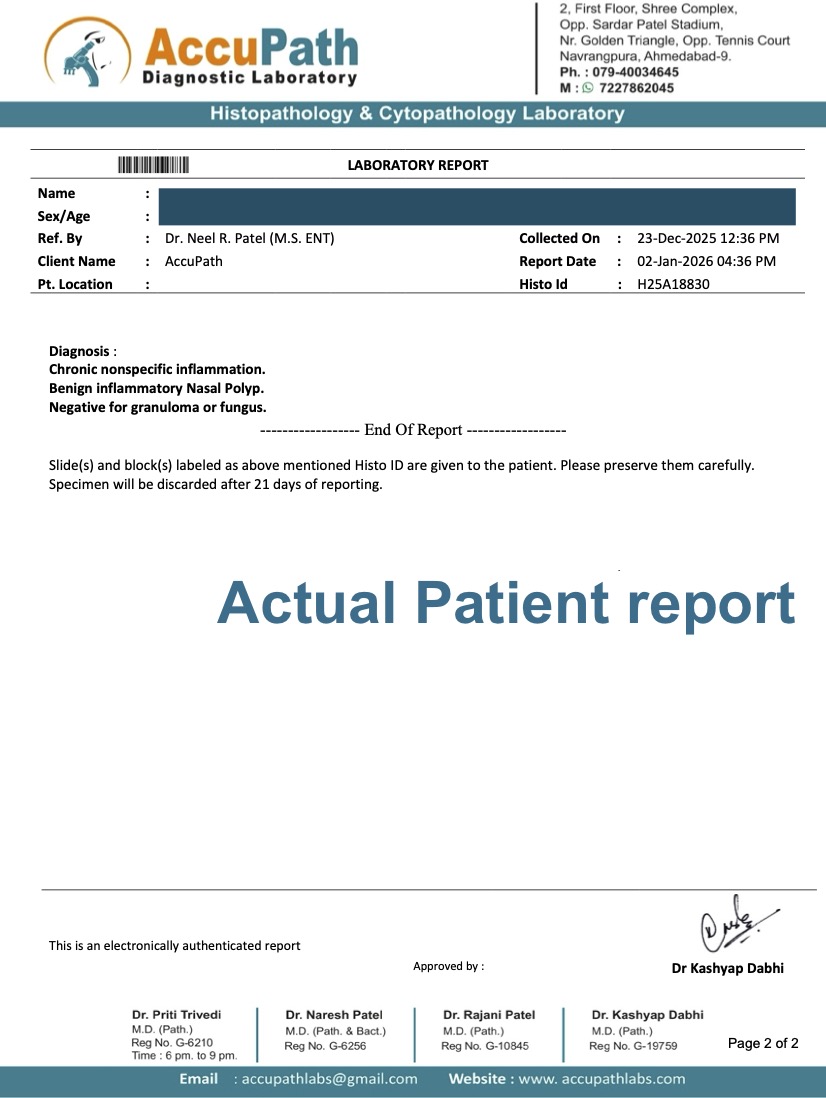
The Biopsy is taken and each patient's report is prepared meticulously as per International Standards that helps the patient understand the pathology and how much m'longer he/she has to continue treatment.

