

Comprehensive
Vertigo Management
A New Era of Precision Diagnosis with VNG, fHIT, and SVV
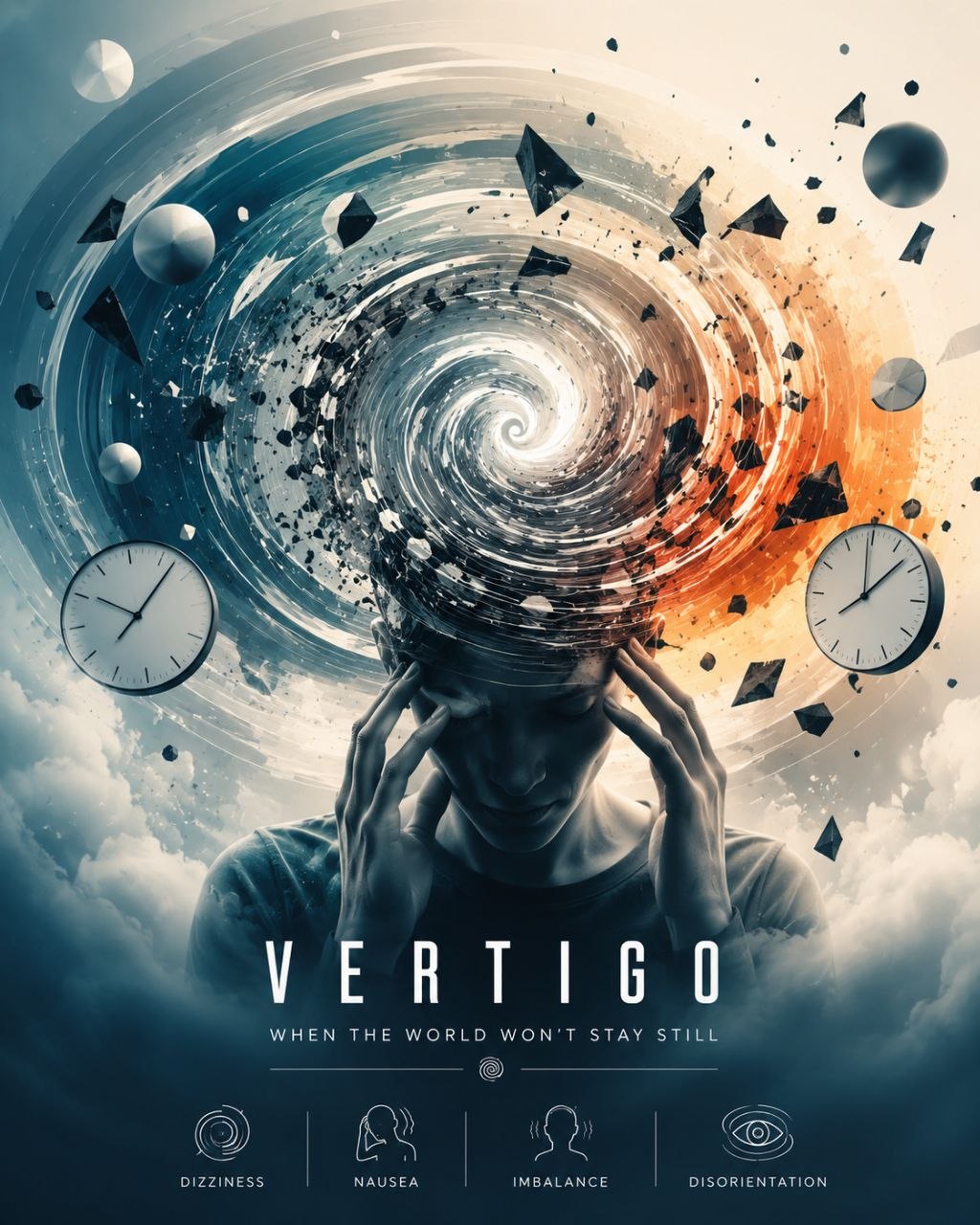
Vertigo is not a disease; it is a symptom of an underlying disruption in the body’s complex balance system. For millions of sufferers, the journey to relief is often frustrated by vague diagnoses and ineffective trials of medication.
The landscape of vestibular medicine in 2026 has shifted from subjective observation to objective, data-driven precision. At our advanced ENT center in Ahmedabad, led by Dr. Neel Patel, we utilize the state-of-the-art Equidor Vestibular System to provide a definitive roadmap for patients suffering from dizziness, imbalance, and spatial disorientation. The integration of Videonystagmography (VNG), Functional Head Impulse Testing (fHIT), and Subjective Visual Vertical (SVV) assessment represents a sophisticated approach that enables precise localization of vestibular dysfunction.
Understanding the Pathophysiology of Imbalance
The human balance system is a marvel of multisensory integration. It relies on the seamless coordination of three primary inputs working in constant unison to keep you upright and oriented.
- The Vestibular System: The inner ear’s semicircular canals and otolith organs that detect rotational and linear acceleration.
- The Visual System: Providing a constant reference of the environment and horizon.
- The Proprioceptive System: Sensory receptors in the joints and muscles that tell the brain where the body is in space.
When these signals conflict—due to inner ear infections, displaced ear crystals (BPPV), or central nervous system issues—the result is vertigo. Traditional “bedside” tests often fail to catch subtle failures in this network. A clinician observing a patient’s eyes can only detect overt corrective movements, entirely missing covert saccades that occur outside the visual axis. This is where advanced vestibular diagnostics become absolutely critical to proper patient care.
1. Videonystagmography (VNG)
Mapping the Ocular-Vestibular Connection
Videonystagmography (VNG) is the cornerstone of modern balance testing. Moving beyond the older electrode-based electronystagmography, VNG utilizes high-speed infrared cameras mounted in specialized goggles to track involuntary eye movements (nystagmus) in total darkness with unprecedented fidelity.
How VNG Works
Because of the Vestibulo-Ocular Reflex (VOR), any stimulation in the inner ear produces a corresponding eye movement. During VNG testing, we perform several critical sub-tests:
- Ocular Tracking: Assessing the brain’s ability to follow moving targets, identifying central (brain-related) causes of vertigo.
- Positional Testing: Moving the head into specific orientations to detect BPPV, pinpointing exactly which canal the crystals are trapped in.
- Caloric Stimulation: Using precisely controlled air or water temperatures to stimulate each ear individually, identifying unilateral weakness common in Meniere’s disease or Vestibular Neuritis.
Research published in The Lancet Digital Health (2026) indicates that VNG-guided diagnosis reduces the “time-to-recovery” for vertigo patients by 40% compared to traditional clinical exams. By identifying the exact ear and canal involved, we can apply repositioning maneuvers with near-100% success rates.
2. Functional Head Impulse Test (fHIT)
Measuring Real-World Vision
One of the most debilitating symptoms of vestibular hypofunction is Oscillopsia—the sensation that the world is “jumping” or blurring when you move your head. The Functional Head Impulse Test (fHIT) is a breakthrough in measuring how well your balance organs support your vision during movement.
The Vestibulo-Ocular Reflex (VOR) is the fastest reflex in the human body. Its job is to move your eyes in the opposite direction of your head movement at the exact same speed, keeping your gaze locked on a target. Traditional tests measure the speed of this reflex, but fHIT measures the functional result: can you actually see clearly during a rapid head turn?
Using the Equidor system, we present a brief visual target during a high-speed head movement. Your ability to identify that target provides a numerical “Percent Correct” score for all six semicircular canals. fHIT is exceptionally sensitive at detecting covert saccades, allowing us to diagnose subtle vestibular damage that explains a patient’s unsteadiness even when other tests appear normal.
3. Subjective Visual Vertical (SVV)
Decoding Your Brain’s Gravity Map
While the semicircular canals detect rotation, the Otolith Organs (Utricle and Saccule) detect gravity and linear tilt. When these organs are damaged, you may feel like you are constantly tilting to one side or that the world is “crooked.”
The Subjective Visual Vertical test provides a fundamentally different window into vestibular function. It measures the higher-order cognitive perception of spatial orientation. In the SVV test, the patient sits in a dark room and uses a controller to align a luminous line to what they perceive to be perfectly vertical. A healthy brain can do this within 1 to 2 degrees of true vertical. Patients with acute vestibular lesions often deviate by 10 degrees or more.
SVV is an essential tool for tracking central compensation. After an inner ear injury, the brain must “re-learn” where vertical is. By measuring SVV deviation over time, we can numerically track your brain’s recovery progress and adjust your Vestibular Rehabilitation Therapy (VRT) accordingly.
The Integrated Solution: Equidor System
In the past, these tests were performed on separate, bulky machines, leading to data fragmentation. The Equidor integrated suite combines VNG, fHIT, and SVV into a single high-fidelity platform. This offers unparalleled medical benefits:
- Cross-Validation: We compare reflexive eye data (VNG) with functional vision data (fHIT) and perceptual data (SVV). This “triple-check” eliminates diagnostic errors.
- Drug-Free Recovery: Once the exact site of the lesion is known, we prescribe Vestibular Rehabilitation Therapy (VRT). Targeted VRT has a 91% success rate in resolving chronic vertigo without long-term sedation medication.
- Objective Proof of Progress: Patients can see their numerical improvement over time on a graph, providing immense psychological relief and motivation.
Advanced Vertigo Care in Ahmedabad
If you or a loved one are experiencing persistent dizziness, frequent falls, or a sense of “brain fog” related to balance, it is time to move beyond temporary relief. Advanced diagnostics are no longer a luxury; they are the standard for excellence in ENT care.
Dr. Neel R. Patel MS ENT
Ahmedabad’s Advanced Otology & Endoscopic Ear Surgeon
✅ Laser & endoscopic expertise | ✅ Vestibular & Balance Disorders
📍 Morning: Shaleen Hospital, Sola (10AM-1PM)
📍 Afternoon: Sunrise Hospital, Gota (3PM-5PM)
📍 Evening: Harsiddh ENT Clinic, Bhuyangdev (5PM-8PM)
📞 +91-9512039041 | +91-9099961261
💬 WhatsApp: +91-8160994252

Leave a Reply